A Short History of Fidget Toys
People were fiddling with things in their hands long before anyone called it fidgeting.
· 5 min read

The short answer
Fidget toys are much older than the word. Greek komboloi worry beads grew out of prayer beads, and Baoding balls take their name from a city in China. Smooth worry stones and squeezy stress balls belong to the same family. Then came the fidget spinner craze of 2017, pop-its a few years later, and today's clickers, many of them 3D-printed.
Worry beads: the komboloi
If you've been to Greece you may have seen someone, often an older man outside a café, flicking a loop of beads over his fingers. That's a komboloi, usually translated as worry beads.
Their roots are religious. Material from the Komboloi Museum in Nafplio, published by the craft magazine Garland, traces them back to monks on Mount Athos who tied knots at intervals on a thick cord to count their prayers. Over time the Greek version lost that purpose. The same piece says Greece is the one place where the beads are no longer about prayer and the komboloi has become an object purely of secular pleasure. A museum worker quoted there says people use them to relax, and some to help them stop smoking.
That's a fidget toy in all but name: something to keep the hands busy while the mind does something else.
Baoding balls
Baoding balls are two (sometimes more) balls rolled around each other in the palm of one hand. According to the encyclopaedia entry on Baoding balls, they're named after the city of Baoding in Hebei province, China, from the Ming dynasty, and they were originally made of iron, which is why they were long known as iron balls. Many modern pairs are hollow with a chime inside that rings as they turn.
Exactly how old they are is harder to pin down, and accounts vary. What's clear is that the basic idea, rolling something smooth and weighty round and round in your hand, has been around for a very long time.
Worry stones and stress balls
A worry stone is about as simple as a fidget gets: a smooth, flat stone with a shallow dip for your thumb, which you rub back and forth. Plenty of cultures are credited with the idea, from ancient Greece to Ireland, but the origins are unclear and poorly documented, so we won't pretend to know.
The stress ball is the squeezy desk-drawer version, the thing you grip during a tense phone call. Ours are not that kind of toy (everything we make is hard PLA plastic), but the squeeze-and-release idea sits firmly in the same family.
Who invented the fidget spinner?
Fidget spinners gained immense popularity in 2017. They ranked among the top-selling toys and games, and they were common enough to be banned by some schools.
At the height of it, many news stories named a chemical engineer, Catherine Hettinger, as the inventor. The facts are more tangled. Hettinger did patent a spinning toy: the application was filed in 1993, granted in January 1997, and the patent expired in 2005 because the maintenance fees weren't paid.
Whether that toy was the fidget spinner is another matter. Bloomberg News asked two patent experts to read it, and one said it doesn't appear to cover the products that people are selling now. Asked about it, Hettinger replied, "Let's just say that I'm claimed to be the inventor." The UK patent firm Reddie & Grose reached a similar view, noting that her patent describes a dome-shaped toy and doesn't discuss a bearing, the part that makes a modern spinner spin for so long.
So the honest answer is that nobody has a clean claim to having invented the spinner as we know it. If you want to compare one with an infinity cube, we've done that in infinity cube vs fidget spinner.
Pop-its
Pop-its, the trays of bubbles you push through one way then the other, felt brand new when they took off. They weren't. The news agency JTA reports that the Israeli toymakers Theo and Ora Coster designed the original pop-it in the 1970s, and that it only became wildly popular decades later, helped along by TikTok.
Clickers and 3D-printed fidgets today
The clicker is a much newer arrival. It borrows the switch and keycap from a mechanical keyboard and turns them into something you hold, with a click you can feel. Our explainer on what a fidget clicker is goes into how they work.
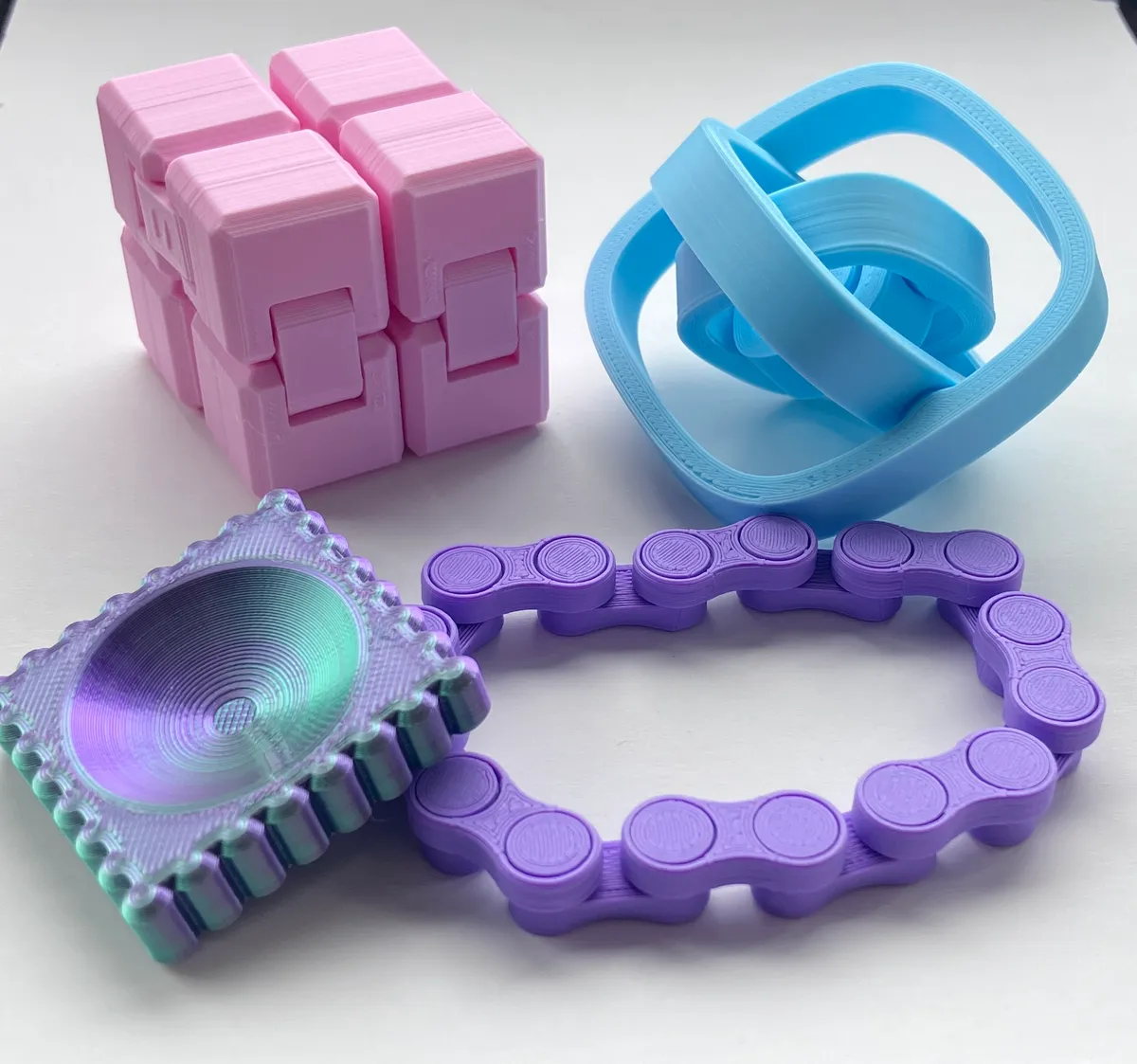
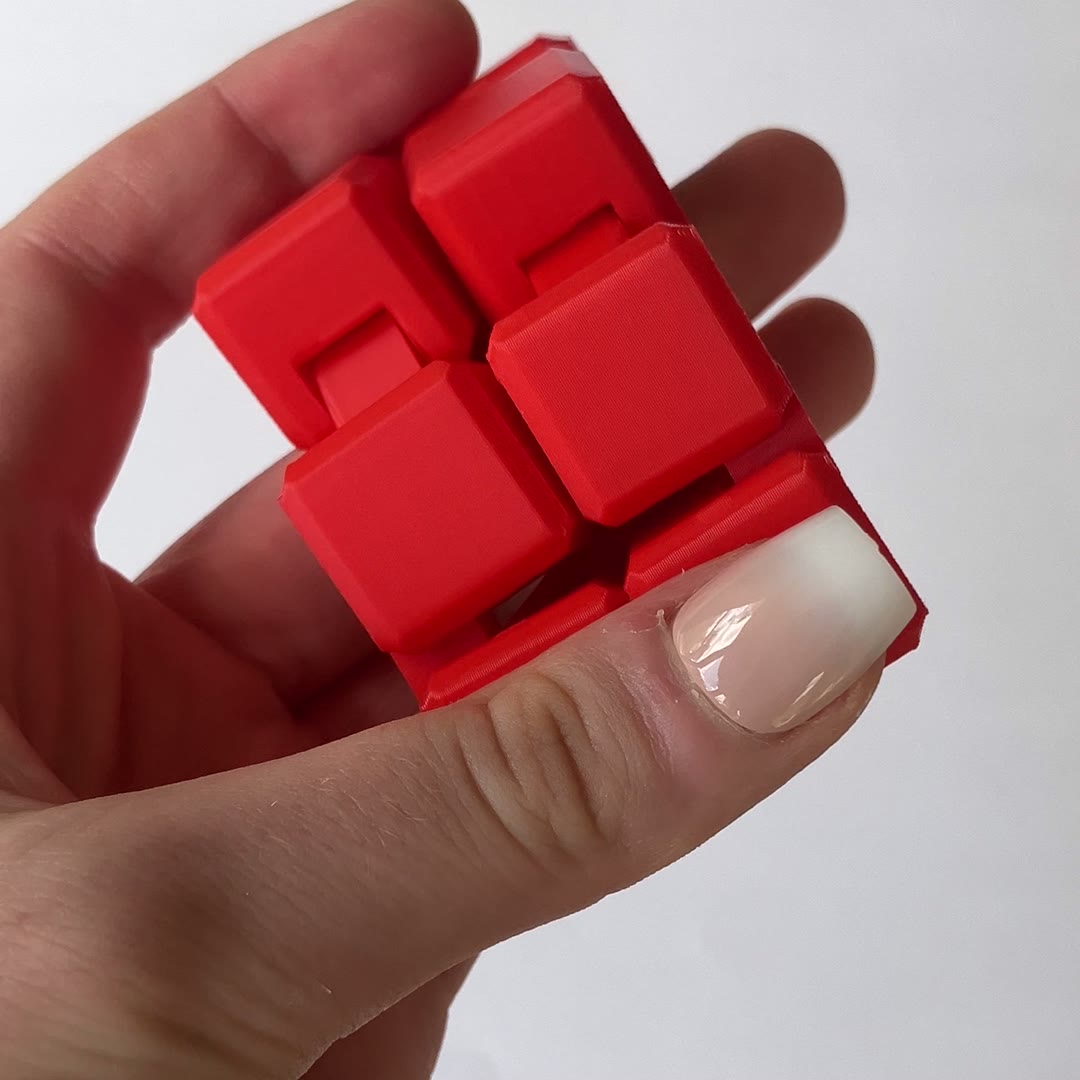
3D printing has changed what a fidget can be. A printer can make a hinged snake or a folding cube in one piece, with joints that move straight off the print bed, and a small workshop can make toys in small batches, in whatever colours its customers pick, instead of shipping thousands of identical ones.
That's how we work. Every toy we make is 3D-printed by us in Kent, in small batches, from PLA, a plant-based polymer, carries the UKCA mark and is made to the UK toy safety standard, BS EN 71. They contain small parts, so they're not suitable for children under 36 months. There's more on the process in our guide to 3D-printed fidget toys.
Questions people ask
What was the first fidget toy?
There is no single first one. Objects such as Greek komboloi worry beads, which grew out of prayer beads, and Chinese Baoding balls were used to keep the hands busy long before modern fidget toys.
Who invented the fidget spinner?
Nobody has a clear claim. Catherine Hettinger patented a spinning toy in 1997 and the patent expired in 2005, but patent experts consulted by Bloomberg said it did not appear to cover modern fidget spinners.
When were fidget spinners popular?
Fidget spinners were a craze in 2017, when they ranked among the top-selling toys and many schools banned them from classrooms.
Who invented pop-its?
Pop-its were designed in the 1970s by the Israeli toymakers Theo and Ora Coster, and only became hugely popular decades later, around the time they spread on TikTok.
What are Greek worry beads for?
Komboloi grew out of prayer beads, but in Greece they are now used without any religious purpose, to relax and keep the hands busy.