Flexi Fidget Animals: How They Work and Why They're So Satisfying
Why a toy made of dozens of little hinged segments is so hard to put down.
· 4 min read

The short answer
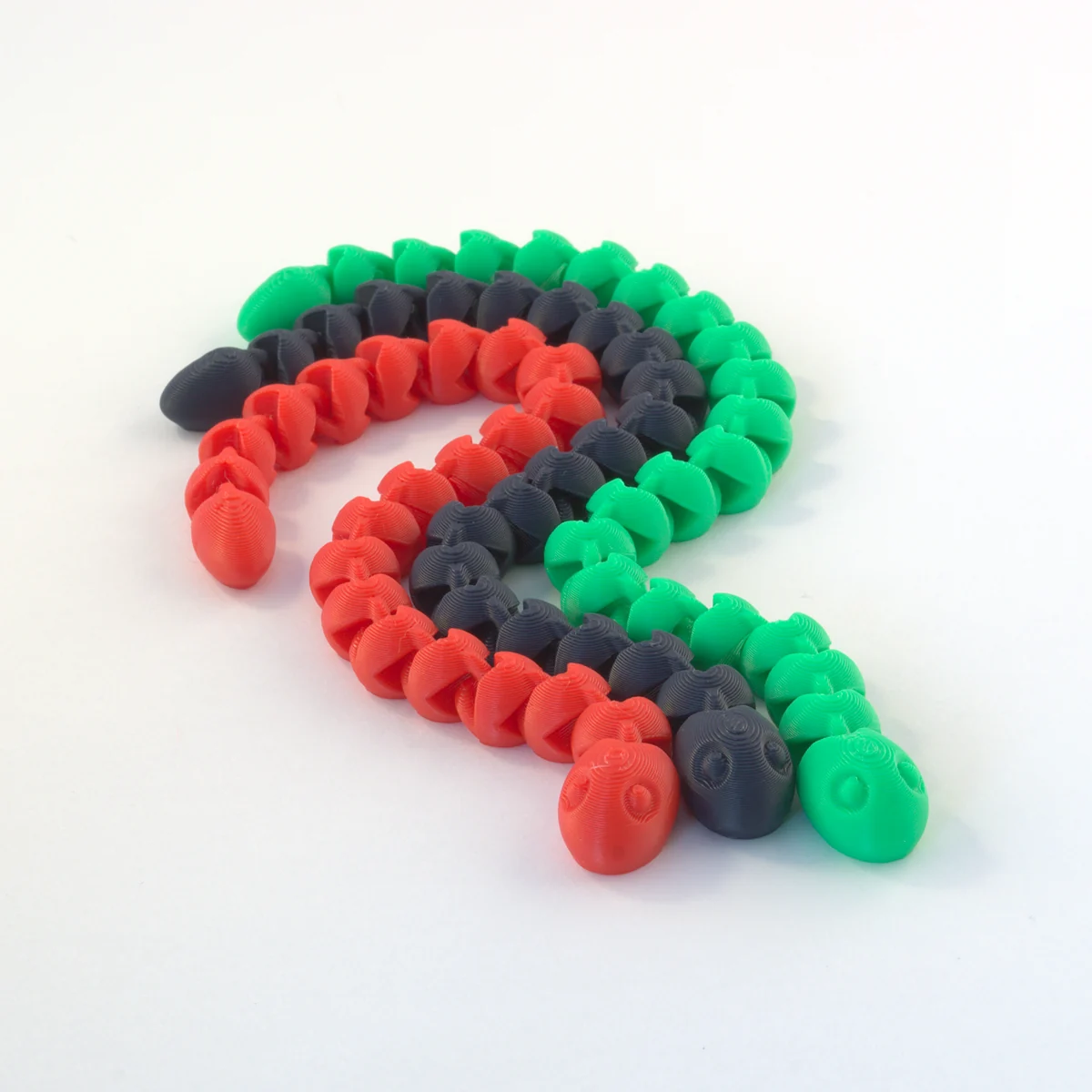
A flexi fidget animal is an articulated toy made from a chain of small segments joined by loose hinges, so the whole body bends, curls and wiggles. On a 3D printer the joints are usually printed in place: every segment is printed already linked to the next, with a tiny gap that lets it move. No glue or assembly needed.
What is a flexi fidget animal?
Picture a toy snake made of lots of short sections, each one hooked loosely onto the next. Hold it by the head and the body swings. Lay it on a table and you can curl it into a coil, then straighten it out again. Run it through your fingers and every segment moves a little on its own.
That's a flexi animal, sometimes called an articulated toy. The snake is the classic shape because a long body shows the movement off so well, but the same idea works for any creature built from a row of linked parts. They became a familiar sight in the 3D printing world because a printer can make the whole thing in one go.
How do print-in-place joints work?
A 3D printer builds an object from the bottom up, one very thin layer of melted plastic at a time. That means it can print one part sitting inside another, as long as the two never touch.
A print-in-place joint uses exactly that. The designer draws each segment with a peg or loop that sits inside a slot on the next segment, and leaves a small clearance all the way round. The printer lays down both parts in the same pass, the clearance stays empty, and when the print comes off the bed the joint already moves.
Getting that gap right is the fiddly bit. Too tight and the plastic fuses, so the joint is stuck solid. Too loose and the segments rattle and can feel sloppy. A good flexi toy sits in between, free enough to swing under its own weight and snug enough to feel like one creature rather than a pile of beads. If you want the bigger picture on how printed fidgets are made, there's more in our guide to 3D-printed fidget toys.
What does a flexi fidget feel like?
It's a loose, flowing kind of fidget. Instead of a single movement repeated over and over, you get a ripple. Wiggle one end and the motion travels down the body. Let it drape over your hand and it settles into a new shape every time.
There's a sound too, a soft clatter as the segments knock together. It isn't a sharp click, but it isn't silent either, so in a very quiet room people may notice it. Our noise levels page compares it with the other types if that matters where you'll use it.
Plenty of people use a flexi toy almost without looking at it, running it back and forth through their fingers while they talk or watch something.
Who are flexi fidget toys good for?
Children tend to love them first as a toy. A snake that wriggles is fun before it's anything else, and it often ends up with a name.
Older kids and adults usually come to them as a fidget. The movement is gentle and endlessly varied, which suits people who get bored of a toy that only does one thing. Some like to have something to drape and coil while they're thinking. Others find the soft clatter calming in a way a click isn't. Teenagers who would never carry a toy that looks babyish often happily keep a snake on their desk; our post on fidget toys for teenagers has more on that age group.
Flexi toys are made of lots of small segments, so they're not suitable for children under 36 months.
How do you look after a flexi snake?
- Don't force a joint past where it wants to go. Each hinge has a natural range. Bending it hard beyond that, or twisting it like a rope, puts strain on a small piece of plastic.
- Keep it away from heat. PLA softens when it gets hot, so a sunny dashboard or a radiator shelf is a bad place to leave it. A warped joint won't move freely again.
- Clean it gently. Warm soapy water and a soft brush, then let it dry fully so no water sits in the hinges. Our guide on how to clean fidget toys covers it step by step.
- Check it now and then. If a segment ever cracks or comes loose, take the toy away from younger children and get in touch with us.
Our flexi toys are 3D-printed by us in Kent from PLA, a plant-based polymer. They carry the UKCA mark and are made to the UK toy safety standard, BS EN 71.
Questions people ask
How does a 3D-printed flexi snake move?
Each segment is printed already linked to the next with a tiny gap around the joint. Because the parts never touch while printing, the joints move freely as soon as the toy comes off the printer.
Do flexi fidget toys need assembling?
No. Print-in-place flexi toys come off the printer in one piece with working joints, so there is nothing to glue or assemble.
Are flexi fidgets quiet?
They make a soft clatter as the segments knock together. It is quieter than a click but not silent, so it can be noticed in a very quiet room.
Are flexi snakes suitable for toddlers?
No. They are made of small segments and are not suitable for children under 36 months.
Why has my flexi toy gone stiff?
Heat is the usual cause. PLA softens when it gets hot, for example left in a car in summer, and a warped joint will not move freely again. Dirt in a joint can also stiffen it, so try a gentle wash first.